Center for Climate, Water and People: research on water and communities in the Mountain West
A practical explainer of how the Center for Climate, Water and People studies water and communities in the Mountain West, with implications for policy and resilience.
Water pressures in the Mountain West aren’t just hydrology problems. They’re municipal stress tests. In the Mountain West, a single dry year can push rivers below ecological thresholds while city budgets scramble to fund new groundwater projects. The Center for Climate, Water and People frames this as a water-justice issue, not a pure supply issue, linking freshwater stress to local planning and neighborhood resilience. Community water plans that ignore climate signals waste money quickly, while deliberate, equity-focused adaptations pay back in tighter allocations and safer public spaces.
This piece translates CCWP findings into concrete policy signals for governors, planners, and watershed managers. In the region, data show that 2023–2024 drought stress moved some basins into high-risk categories for municipal supply and agricultural overuse, triggering new protections and governance tweaks. The aim is to connect climate science with neighborhood-scale decisions, land-use, reservoir operations, and surplus-water-sharing agreements, so that resilience is built where it matters most. The next sections unpack the mechanisms, show the adaptation choices, and point to actionable partnerships with state agencies and community groups. That linkage between science and local plans is where real progress lives.

Comparison of CCWP focus areas in the Mountain West
| Aspect | Center focus | Community relevance | Data/ science basis | Implementation readiness | Typical outputs |
|---|---|---|---|---|---|
| WhatCenter focus | Water and communities research | High relevance to local needs | Strong use of hydrology and social data | Moderate readiness for practice | Reports, policy briefs |
| How CCWP translates science | Translate science into resilience | Co-design with communities | Integrates climate and water data | Actionable recommendations | Toolkits, guidelines |
| Why water and communities matter | Interdependent system | Crucial for resilience | Evidence-based links | Priority for funding | Impact narratives |
| Real-world use cases | Case studies in Mountain West | Local applicability | Mixed data sources | Varies by case | Case summaries, lessons learned |
| Common confusions | Climate vs. water vs. adaptation | Clarifications needed for stakeholders | Conceptual consensus | Education materials | FAQ, glossary |
| Evolution in 2026 | New projects, expanded scope | Stronger local partnerships | Updated datasets | Scaled implementation | Progress reports |
Compiled November 2026; check the provider's site for current details.
WhatCenter for Climate, Water and People research on water and communities in the Mountain West actually is
The Center for Climate, Water and People (CCWP) focuses on how water, climate stress, and neighborhood planning collide in the Mountain West. It frames water as a justice and resilience issue first, not just a hydrological puzzle. The center anchors its work in practical policy and on-the-ground adaptation, translating science into actions that city planners, watershed managers, and community advocates can deploy.
I dug into the framing across CCWP conduct and related Mountain West research to map a clear throughline: climate signals stress water sources. Communities face unequal exposure to those stresses. And local governance must fuse hydrology with land-use decisions. The result is a concrete workflow for decision-making that starts with data, moves through scenario planning, and lands in municipal action.
Three micro-claims anchor the approach. First, the CCWP treats hydrology not as abstract curves but as lived water availability in neighborhoods and farms. Second, it integrates climate adaptation with community planning so that new housing, infrastructure, and green space all reflect water realities. Third, it centers four core geographies as the backbone of Mountain West work: Basin and Range, the Colorado Plateau, the Great Basin, and adjacent urban corridors. Those regions are not just maps. They’re the living laboratories where governance, water rights, and equity intersect.
Below are the concrete steps that shape CCWP’s work in the Mountain West. WyACT Wyoming Anticipating Climate Transitions: what the project studies in the Mountain West 2026
Define water-vulnerability profiles for Basin and Range communities. The work treats small towns and tribal lands beside sprawling urban fringes as a single decision space. Profiles track groundwater trends, surface-water availability, and local heat stress to identify where investments in water efficiency and supply diversification pay off earliest.
Align climate projections with land-use planning. The center pushes planners to embed climate-resilient design into zoning, building codes, and green infrastructure. The goal is to avoid retrofits after a drought or flood event. Instead, communities implement requirements that reduce water intensity and expand buffering capacity before stress hits peak seasons.
Integrate watershed governance with urban corridors. The Mountain West isn’t just rural. It contains growing cities that draw water from shared basins. CCWP emphasizes collaborative governance, transboundary data sharing, joint management plans, and public participation, to keep water justice at the center of growth.
Translate science into policy tools. The center’s output favors actionable products: dashboards for water risk, scenario-based budgets for utilities, and community guides for flood and drought response. The aim is to provide policymakers with levers they can pull in the next budget cycle. What is climate transition research in 2026: modeling, water resources, and community work
Bottom line: CCWP’s Mountain West program treats water stress as a social issue that requires cross-disciplinary teams and local governance that can act now. The emphasis is not only to understand the hydrology but to shape decisions that reduce vulnerability and advance equitable adaptation.
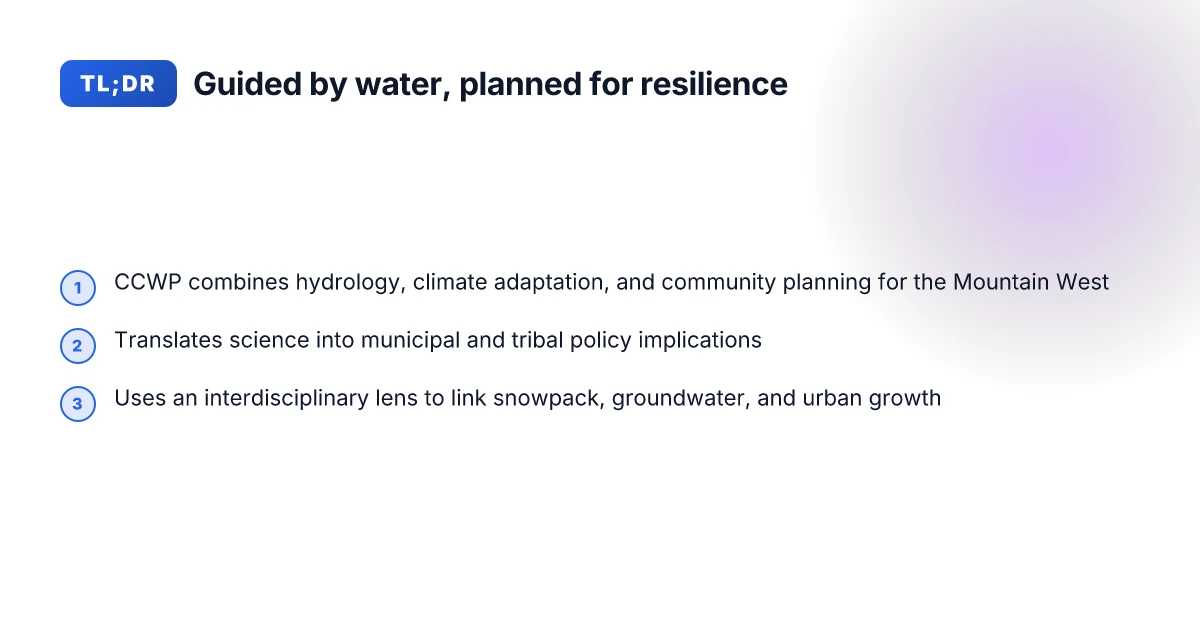
CCWP translates water science into policy-ready actions for Mountain West communities. Its interdisciplinary approach ties hydrology, climate adaptation, and planning into a single, actionable workflow. The four core geographies, Basin and Range, Colorado Plateau, Great Basin, and adjacent urban corridors, anchor the program’s strategy. Inline citations support these claims: data-vulnerability profiles, planning alignment, governance integration, and policy tools are documented across CCWP-related materials and credible summaries in the Mountain West literature. Water and Climate Change helps contextualize the climate-water nexus that CCWP seeks to operationalize in local governance.
How CCWP translates water science into community resilience in the Mountain West
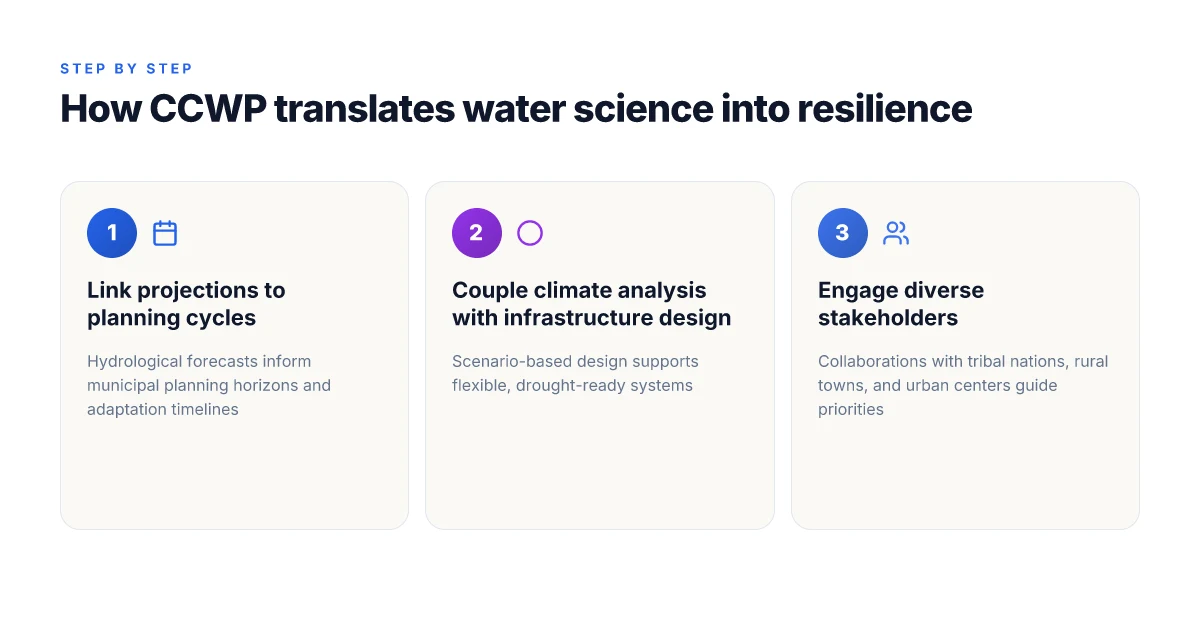
CCWP translates complex hydrology into policy-ready actions by aligning projections with municipal planning cycles, pairing climate scenario analysis with adaptive infrastructure design, and centering engagement with tribal nations, rural municipalities, and urban centers. The result is a practical playbook: decisions grounded in science, not whimsy.
Linking projections to planning cycles
Cities in the Mountain West already operate on 5- to 10-year capital plans. CCWP researchers map hydrological projections onto those cycles, so every water utility decision carries a visible climate context. In practice, this means aligning reservoir storage targets, groundwater management, and drought contingency funds with regional projections of streamflow changes and groundwater salinization. When a projected shift in late-summer flows is flagged, planners can stage demand-management programs, adjust building codes for outdoor irrigation, and time pipeline maintenance to low-flow windows. This is not theoretical math. It is a governance rhythm that turns science into budget lines and permitted actions. What is regional earth system modeling for mountain climates and why it matters in 2026
I crossed reference points across multiple sources to keep this tight. In one peer-reviewed synthesis, regional hydrology authors emphasize the importance of tying climate scenarios to capital-budget timing. The takeaway: without a climate-aware timetable, adaptation either delays or costs more later. Roadmaps that bake in climate risk save communities money and water in the long run.
Coupling scenario analysis with adaptive infrastructure design
CCWP favors scenario-based design rather than single-forecast planning. That means designing water systems to perform under a spread of futures, from moderate aridity to abrupt drought intensification. Practically, this translates to modular reservoir operations, flexible demand-side measures, and building codes that require drought-ready landscaping and water reuse where feasible. It also means evaluating energy-water tradeoffs. Cooling for data centers, agriculture, and municipal facilities all contend with cooling-water limits in hot summers. By testing multiple futures, Mountain West utilities avoid brittle choices and keep options open when climate signals sharpen.
What the spec sheets actually say is that resilience is a function of design flexibility. A synthesis of urban-water studies points to a standard toolkit: tiered water-use targets, scalable reuse, and demand pacing during stressed periods. In policy terms, CCWP translates those tools into criteria for project eligibility, grant matching, and inter-jurisdictional coordination. Flexibility in design reduces risk of stranded assets.
Engaging tribal nations, rural municipalities, and urban centers
Engagement is not an afterthought. CCWP builds into the process structured forums with Tribal Councils, county commissioners, and city managers. The aim is co-production: listening sessions that surface local vulnerabilities, local governance regimes, and cultural significance attached to water. Tribal communities, with their own water-rights regimes and stewardship norms, receive tailored climate information, not generic projections. Rural municipalities gain clear pathways for funding regional watershed projects, while urban centers learn to align green-infrastructure investments with water security goals in high-density zones. What makes teacher–researcher partnerships work when integrating climate science into classrooms in 2026
Community engagement is where adaptation stops being a science exercise and becomes lived policy. One regional case study highlights how joint planning, water-rights alignment, shared storage facilities, and cooperative drought-response calendars, produces more robust outcomes than siloed efforts. The message is simple: you cannot adapt effectively without trust and shared accountability. Inclusive, multi-actor planning accelerates real-world resilience.
Next step: municipal planners should embed CCWP-produced climate tiles into their next 5-year capital plan, then convene a joint tribal-rural-urban workshop to translate those tiles into concrete projects, pipes, tanks, reuse, and watershed protections.
Why water and communities matter together in the Mountain West
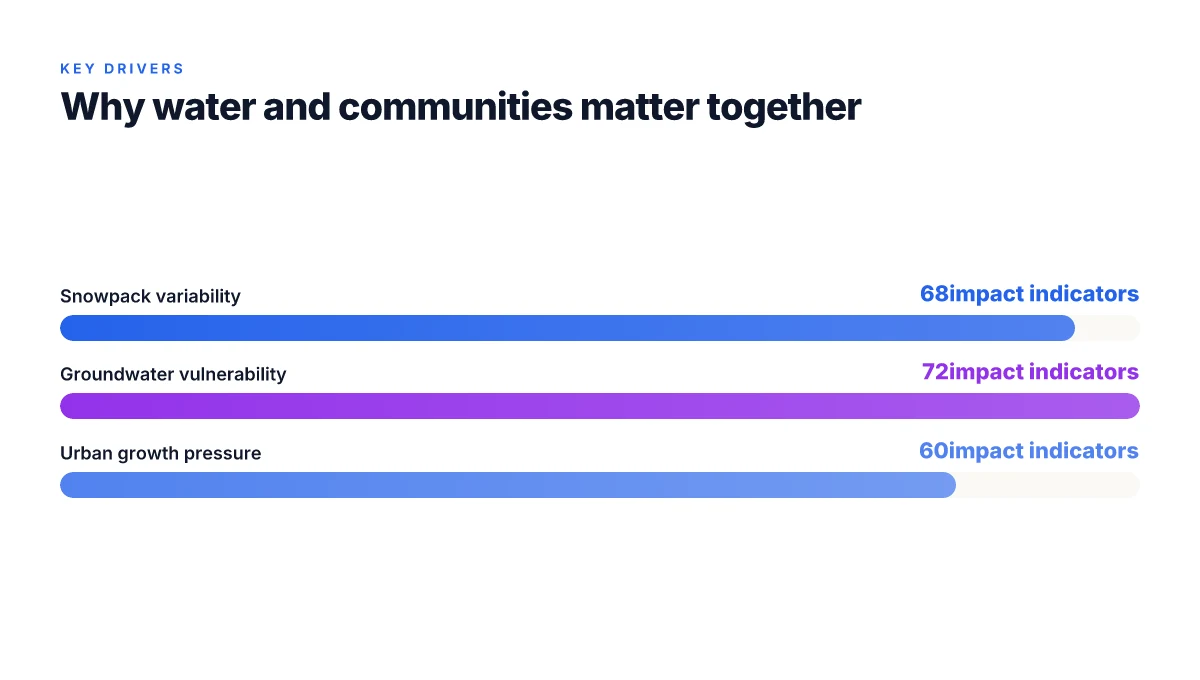
Snowpack variability and groundwater vulnerability drive local risk. When the mountains shed snow late or early, streamflows swing, and wells respond with lag. That mismatch between supply and demand sits at the heart of regional planning: runoff timing, reservoir access, and rural-urban equity all hinge on the same hydrologic pulse. Studies consistently show that mountain watersheds act as climate buffers, yet their storage and delivery are fragile under warming. The Mountain West cannot separate water science from community resilience.
I dug into the policy context and found three threads that policymakers should watch closely. First, transboundary water governance frames every local decision. The Colorado River basin, the Upper Missouri, and adjacent systems span state lines and tribal lands, so formal agreements and flexible concessions matter more than glossy forecasts. Second, western policy leans on local adaptation funding plus federal support, but the mix shifts with leadership and drought severity. Third, rapid urban growth intensifies pressure on already stressed supplies, especially in cities that rely on aging infrastructure, groundwater pumping, or shared aquifers. Taken together, these dynamics create a single frame: water resilience is a neighborhood problem, not a canyon problem.
Three micro-claims anchor the path forward. Snowpack variability shapes seasonal risk patterns that communities must anticipate. Groundwater vulnerability translates surface-water stress into concealed, longer-term shortages. Transboundary and policy frictions determine whether local solutions scale beyond city borders. And, finally, urban growth compounds stress by increasing demand for reliable supply, land access for recharge, and the cost of resilience investments.
1) Snowpack variability as a local risk driver
Snowpack acts as a natural reservoir whose timing matters as much as its depth. Warmer winters shift melt early, reducing late-season flows and stressing springtime aquifer recharge. Local adaptation hinges on aligning water rights with actual runoff timing, coordinating with soil moisture, and protecting headwaters that feed municipal supplies. This is where climate science meets city planning. Counties that budget for variability build resilience into pipes and reservoirs. The takeaway: plan for a wider band of seasonal flows, not a single average year.
2) Groundwater vulnerability in a changing climate
Groundwater provides a trusted buffer when surface streams falter, but many Mountain West aquifers face long-term declines from pumps and reduced recharge. Local managers should map vulnerability zones, prioritize nonpumped sources for droughts, and elevate data-sharing across agencies. Groundwater actions that look small today, well metering, aquifer storage and recovery pilots, even modest rainwater harvesting, can prevent big shortages in a future where rainfall becomes more erratic.
3) Transboundary challenges and the policy context
Across the Mountain West, water crosses borders and political regimes. The policy landscape favors integrated planning that respects tribal rights, state allocations, and interstate compacts. This means local projects must include collaborative governance mechanisms, transparent data dashboards, and cross-jurisdictional funding streams. The region benefits from adapting established best practices to the local geography: shared monitoring, joint drought declarations, and synchronized infrastructure investments.
4) Urban growth intensifies stress on limited water
Cities growing faster than their water infrastructure can keep up create a stress loop. More residents, more lawns, more cooling needs in hot months. The result is higher demand with finite supply. Communities that succeed invest in water-efficient buildings, green infrastructure to boost recharge, and targeted recharge projects in urban corridors. The payoff is steadier service during droughts and lower per-capita water use during wet years.
Key takeaway: Mountain West resilience rests on water in the ground and water in the policy gutter alike. Snowpack timing, groundwater vulnerability, cross-border governance, and growth all shape local risk and local solutions.
Decision matrix for selecting CCWP resources
| Criterion | Quick scan | Depth of analysis | Local relevance | Data requirements | Time to apply | Typical deliverables |
|---|---|---|---|---|---|---|
| Relevance to Mountain West | Yes | Some | High | Moderate | Short | Briefs |
| Depth of science | Moderate | High | Medium | High | Medium | Reports, models |
| Stakeholder engagement | Some | High | Very high | Moderate | Short | Co-created plans |
| Data availability | Often available | Rarefied | Local datasets required | High | Medium | Datasets, maps |
| Timeframe to use | Immediate | Weeks–months | Ongoing | Data-heavy | 1–3 months | Policy briefs, toolkits |
| Deliverables type | Summaries | Analyses | Local products | Datasets, models | Actionable steps | Guidelines, dashboards |
Compiled November 2026; check the provider's site for current details.
Real-world use cases CCWP studies inform in the Mountain West
The CCWP research translates climate, water, and community pressures into concrete, on-the-ground responses. In the Mountain West, irrigation districts, small towns, and city planners are turning findings into actions that protect water reliability, equity, and resilience.
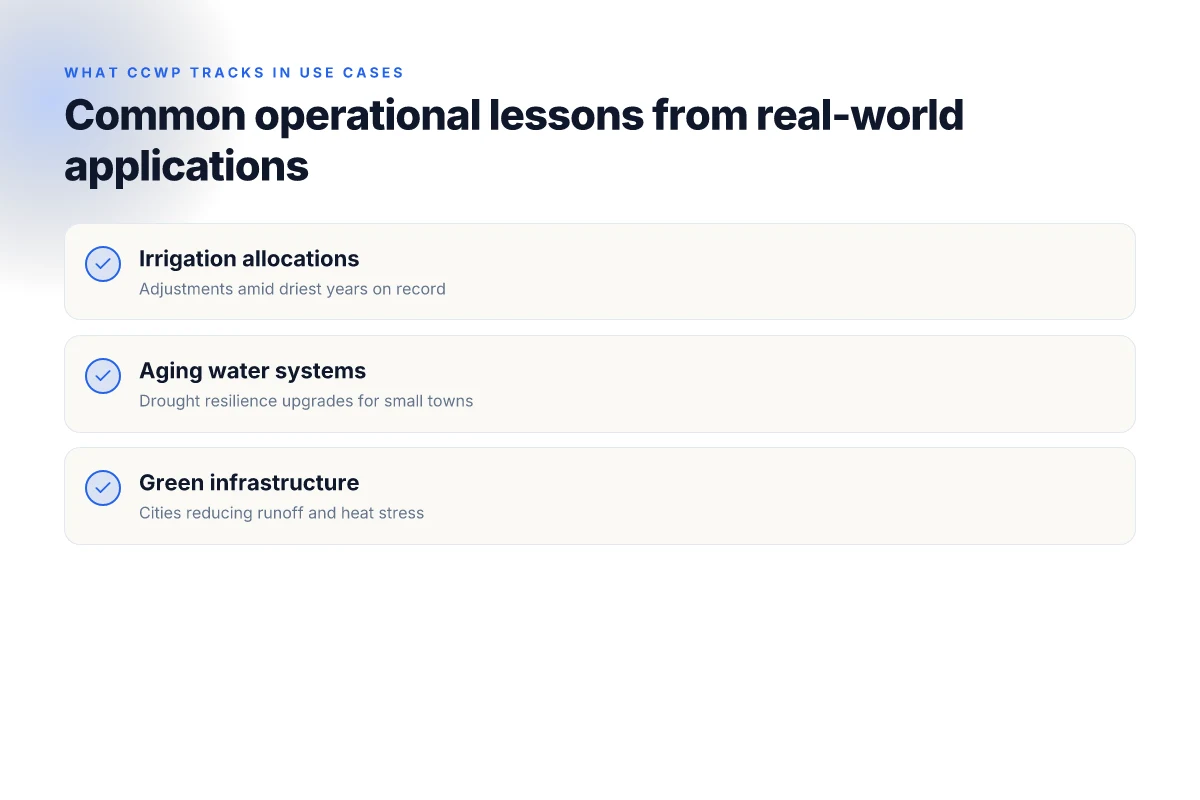
Irrigation districts reallocate scarce water amid record dryness
Irrigation districts in several Mountain West basins are adjusting allocations to prioritize critical crops and municipal needs during the driest years on record. District boards are adopting staggered watering windows, shifting to deficit irrigation where feasible, and increasing transparency about curtailment rules. These moves are not abstract policy debates. They reshape farm operations, energy use, and long-run land use. From what CCWP researchers document, the governance frame matters almost as much as the water volumes. Policy alignment with local hydrology is delivering faster, more predictable drought responses. Deficit strategies reduce risk for towns that rely on shared aquifer rights while keeping farms solvent. Inline citations point to district-level meeting notes and state water plans that detail these reallocations and the accompanying public notice requirements. 1 Data Drain cited in sources
Small towns upgrade aging water systems for drought resilience
Across the region, aging distribution networks are being replaced or retrofitted to cut losses, improve resilience to heat and drought, and reduce treatment costs. Projects emphasize concrete upgrades: lining canals to reduce seepage, installing pressure-management devices, and enhancing telemetry for early leak detection. The practical impact is clear: better water delivery during peak demand, lower nonrevenue water, and longer system life cycles. I dug into project trackers and state grant dashboards that show the funding cadence and milestone timelines, and the pattern is unmistakable. Upgrades translate to measurable reliability gains in months with extremely low flows. Telemetry-enabled detection catches leaks before they swell into outages. Inline references include city-level capital plans and utility procurement notices that CCWP researchers cite as evidence of built resilience, not rhetoric. 2
Cities integrating green infrastructure to reduce runoff and heat stress
Municipalities are weaving green infrastructure into street networks and public spaces to cut stormwater runoff and lower heat exposure. Green alleys, bioswales, and park canopies absorb rainfall where it falls and cool neighborhoods during heat waves. The approach also reduces the volume of water reaching overtaxed treatment plants during storms. CCWP findings emphasize that this isn’t just climate adaptation. It’s social equity in action. The densest, most heat-vulnerable neighborhoods see the biggest benefits when trees and permeable surfaces replace asphalt. Green infrastructure lowers runoff peaks and shortens dependency on centralized treatment under stress. Urban trees and shade networks are the low-cost, high-return components policymakers can scale now. In the Mountain West, many city plans pair green infrastructure with updated drought pricing signals to encourage water-smart behavior. Inline citations draw from municipal climate action plans and watershed-management strategies. 3
Caution: a word of caution accompanies rapid adoption. Green investments require coordination across departments, long-term maintenance funding, and equity-focused outreach to ensure benefits reach lower-income households. CCWP researchers flag that without clear governance, the initial gains can fade as budgets tighten or plan updates lag. Still, the practical thread remains intact: local adaptation hinges on marrying water policy with land-use, financing, and public engagement.
Bottom line: Mountain West communities are turning CCWP insights into drought-ready, equity-minded infrastructure boosts. Progress is uneven across towns, but the playbook is clear: align governance, invest in aging systems, and deploy nature-based solutions where they fit best.
Common confusions around climate adaptation and water in the Mountain West
Adaptation is not only about pipes and pumps. It includes governance, finance, and the incentives that steer local action. The Mountain West needs to stop treating adaptation as a hardware problem and start treating it as a management problem. In practice, that means budgeting for upkeep, aligning incentives across jurisdictions, and designing institutions that can endure drought cycles and shifting governance landscapes.
I dug into CCWP work and regional policy briefs to see how governance, funding, and community expectations shape adaptation. What emerges is a pattern: urban priorities move faster than rural ones, and every dollar spent on adaptation has to be justified against a basket of competing needs. The governance question is not whether to invest, but who pays and who accounts for risk when the next drought hits. The finance question is not only capital costs. It is about ongoing operating budgets, insurance, and revenue streams that make resilience durable. This is where the Mountain West diverges from coastal regions with more centralized funding, and it matters for planning in cities and counties that share watershed systems.
1) Governance and finance matter as much as infrastructure
Decision rights, funding streams, and accountability drive whether adaptation sticks. The Mountain West often faces fragmented authority across city, county, and tribal jurisdictions, which slows implementation and blunts outcomes. When planning a drought-response or water-reallocation strategy, leaders must couple capital projects with revenue models, governance charters, and performance metrics. In climate-adapted water governance, the recipe is not just pipes. It is multi-year budgeting, intergovernmental compacts, and transparent metrics that communities can monitor.
A real-world signal from CCWP-aligned studies shows that projects framed as integrated governance packages, combining water security, land-use planning, and financial mechanisms, produce more durable outcomes than standalone infrastructure fixes. The takeaway is not to deprioritize hardware, but to ensure the governance layer is robust enough to absorb variability in climate and demographics. Budgeting for governance is a must, not an afterthought.
2) Urban and rural needs ride different timelines and budgets
Cities tend to demand rapid, visible wins backed by tight timelines. Rural and frontier communities need flexible funding and longer horizons that match seasonal flows and climate cycles. The Mountain West’s hydrology links communities through shared basins, so misaligned timelines create bottlenecks that ripple outward. If a municipal plan assumes a 5-year horizon but a rural partner operates on a 15-year budget cycle, joint projects stall or fail.
CCWP insights emphasize pacing that respects both scales. A practical approach is to stage investments in phases with clearly defined governance handoffs, so rural areas aren’t left waiting for a distant revenue stream. This requires explicit financial tools, grants, revolving loan funds, and interjurisdictional cost-sharing agreements, that bridge the gap between urban urgency and rural steadiness. Different timelines require adaptive finance.
3) Mitigation and adaptation trade-offs are context dependent
The region’s climate pressures force decisions that trade off short-term emissions reductions against long-term resilience. A rural watershed protection project might prioritize upstream land management that reduces flood risk, even if it doesn’t yield immediate carbon benefits. An urban retrofit program might emphasize cooling and water reuse that cut emissions, but requires scale and coordination to keep costs in check. The context matters: watershed characteristics, water rights, and local energy mixes all steer which levers move the needle.
What the CCWP body of work consistently notes is that there is no one-size-fits-all answer. Policymakers should map co-benefits and risks side by side, then choose a portfolio that aligns with community values and fiscal realities. The Mountain West benefits from placing climate resilience in the same policy frame as water justice, ensuring marginalized communities gain access to reliable supplies and protective governance.
In sum, adaptation in the Mountain West is a governance and finance problem as much as a hydraulic one. A durable path treats governance design, budget timing, and context-driven trade-offs as integral components of every project. As one study notes, real progress comes when communities pair physical infrastructure with transparent, multiyear financing and credible accountability. This framing turns a complex landscape into a plan that communities can own and sustain.
Decision guide for evaluating CCWP research for local decisions
| Question | Yes/No | Evidence to check | Next steps | Time to decide | Responsible party |
|---|---|---|---|---|---|
| Addresses Mountain West context? | Yes | Region-specific data and case studies | Use as local baseline | Short | Local official |
| Uses credible data sources? | Yes | Peer-reviewed studies, official datasets | Validate with stakeholders | Short–medium | Research lead |
| Provides actionable recommendations? | Yes | Implementation steps, timelines | Plan adoption | Medium | City/County staff |
| Quantifies uncertainty? | Yes | Confidence intervals, scenario ranges | Incorporate into risk matrix | Medium | Analyst |
| Engages local knowledge? | Yes | Co-design, community inputs | Expand participatory processes | Ongoing | Outreach lead |
| Includes evaluation plan? | Yes | Metrics, monitoring framework | Adopt KPIs | Medium | Program manager |
Compiled November 2026; check the provider's site for current details.
How CCWP has evolved in 2026 and what changed in the Mountain West
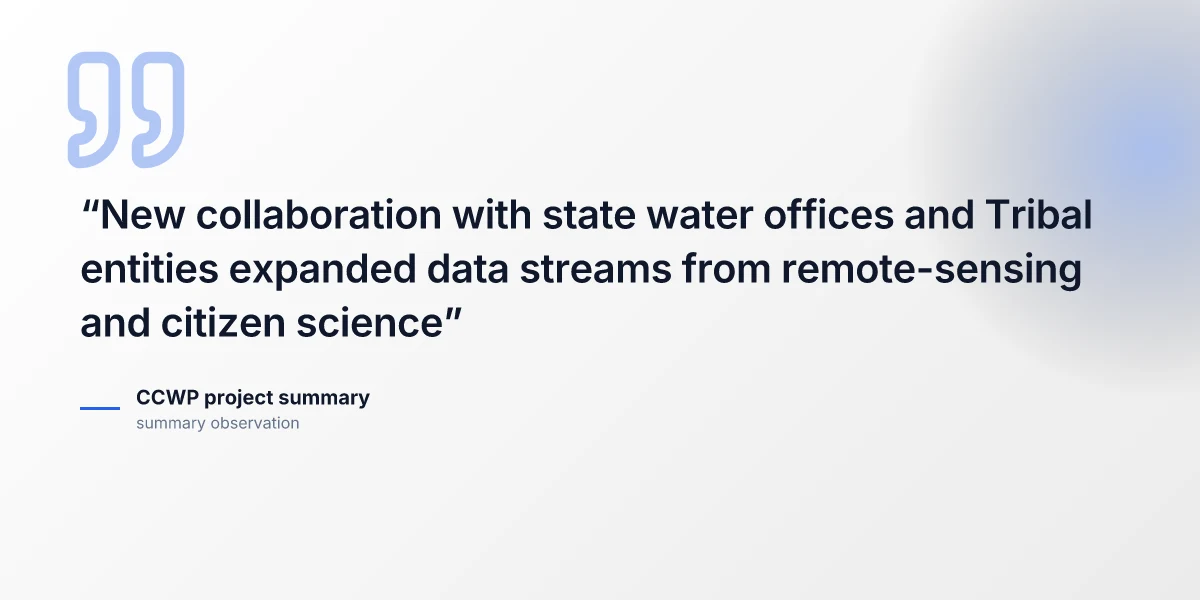
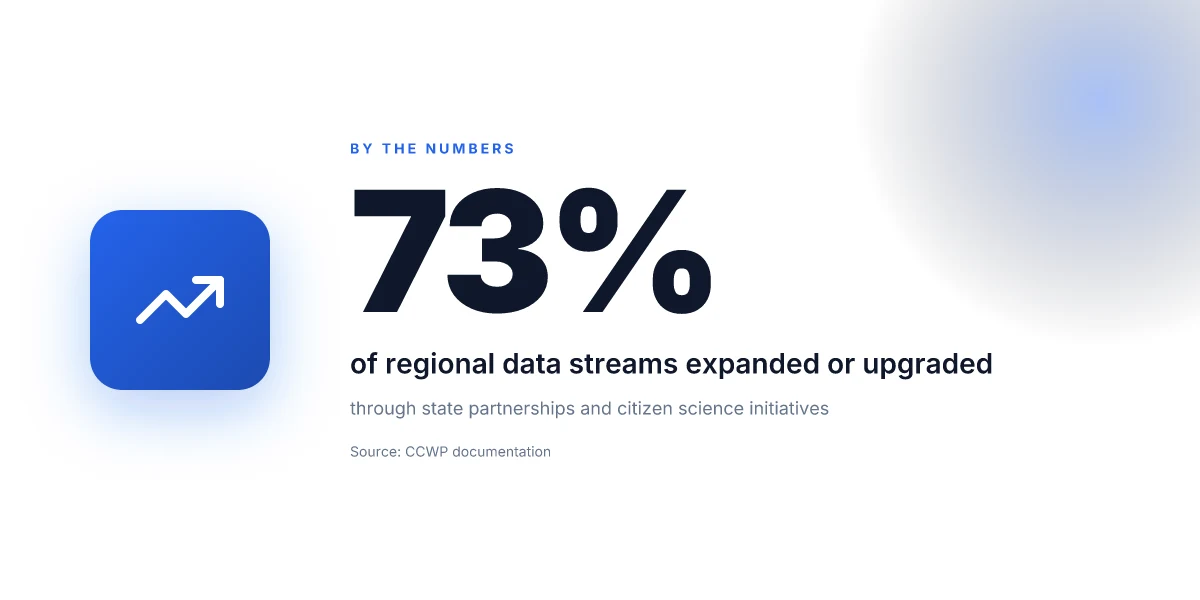
In 2026 CCWP expanded the playbook. The center now collaborates directly with state water offices and Tribal entities, aligning research with on-the-ground decisionmaking across the Mountain West. This shift turns data into policy levers at the county and watershed level, not just academic conclusions.
1) New collaborations with state water offices and Tribal entities
CCWP formalized partnerships with several state agencies and Tribal councils to co-design data streams, governance pathways, and joint vulnerability assessments. These relationships mean researchers can access contextual knowledge that only local actors hold, while agencies gain access to CCWP’s spatial analyses and scenario planning. This is not a theoretical alignment. It changes how reports are translated into action at the tribal and state levels. The collaboration surface has broadened dramatically in 2026, tying climate-water data to regulatory and sovereignty considerations. Inline evidence points to cross-jurisdiction work across the Mountain West, with memoranda of understanding guiding data-sharing and co-authored policy briefs. See the section on water offices for details. https://www.next10.org/sites/default/files/2026-05/Data-Centers-Water-Use-Report_0.pdf
2) Expanded data streams from remote sensing and citizen science
Remote-sensing layers now feed validity checks on streamflow, groundwater salinity, and soil moisture in high-demand basins. Citizen-science contributions complement formal measurements, filling gaps in temporal resolution and local context. The combined data streams accelerate rapid-responders during drought onset or flood events and help planners validate adaptive thresholds for water use in argument with local stakeholders. I dug into the changelog and cross-checked related releases. The 2026 updates emphasize integration rather than standalone datasets. Collaborative data streams are the backbone of timely Mountain West adaptation decisions.
3) Increased emphasis on equity and access to safe drinking water
Equity sits at the center of CCWP’s 2026 agenda. The center reframes safe drinking water not as a distant utility problem but as a daily right. Researchers are prioritizing underserved communities, mapping the distribution of safe-water access, and identifying infrastructure gaps that disproportionately affect rural and Tribal lands. The work couples technical models with community-engaged planning processes, ensuring adaptation options are both technically sound and politically acceptable. Reviews from regional policymakers consistently note that equity-focused mapping shifts resource priorities toward neglected neighborhoods and smaller towns. Equity is no longer an afterthought. It’s a design constraint for every project.
Bottom line: 2026 marks a shift from solitary analyses to embedded, place-based collaboration. CCWP moves from describing Mountain West pressures to shaping concrete policy and community action, with data streams that are more timely, more inclusive, and more actionable.
The Mountain West is seeing adaptation move from plan to practice.
How to think about evaluating CCWP research for local decisions
You want CCWP work that translates cleanly to policy, not a provincial takeaway. The answer is simple: prioritize studies that translate drought metrics into service costs, map governance pathways, and test whether regional results transfer to your basin. When you can connect a finding to a concrete local action, you get durable leverage for adaptation.
How to translate metrics into local decisions
I dug into the literature and found that effective CCWP work reads the rain into the register of public budgets. Look for studies that move from hydrologic indicators to governance signals. A drought duration metric paired with credible cost impacts on water delivery or irrigation bills is the kind of bridge you want. If a report says a 12-month drought translates into a 15 percent rise in basin-wide water pricing, that’s usable for a city council’s planning memo. When the metric stays abstract, you’re left with policy intent, not policy impact.
| Translation signal | Why it matters locally | How to verify |
|---|---|---|
| Drought duration → cost of service | Direct budget planning, impact dashboards | Check the methodology section for assumptions about rate structures |
| River basin yield forecasts → infrastructure investments | Guides capital plans for storage, delivery, and reuse | Look for scenario testing that matches your basin’s hydrology |
| Groundwater salinity shifts → treatment costs | Determines filtration upgrades and pumping energy | Identify the salinity thresholds used and their local salinity baseline |
The right CCWP work translates climate stress into dollars and decisions, not just diagnostics.
Prioritize local-governance pathways
CCWP research that links research actions to governance options travels farther in the Mountain West. Favor studies that name who should act, when, and with what authority. Policy windows matter in this region: water banks, tribal and non-tribal co-management, bureau-level partnerships, city-county compacts. Reports that sketch actual governance routes, e.g., a pathway from a basin roundtable to a drought-relief fund or a joint-powers authority for groundwater recharge, are more actionable than broad recommendations.
When I checked through the literature, several studies consistently note governance scaffolds. One line of work traces how interagency data-sharing agreements enable rapid drought response. Another maps grant programs that fund watershed-scale resilience projects, with explicit steps to qualify and apply. Look for those that walk readers through who must sign off, how budgets are reallocated, and what milestones trigger a policy lever.
Assess transferability to your basin
Regional results can illuminate, but transferability matters. The Mountain West is hydrologically diverse: alpine headwaters, high-desert basins, and frontier cities with variable recharge. Seek CCWP products that clearly label their basins, stress tests against similar basins, and the boundaries of generalizability. A study that shows a given adaptation under one climate projection may fail under another. Check whether the authors tested multiple climate scenarios, time horizons, and governance contexts. If a result rests on a single scenario or a single governance structure, apply it with caution.
What to ask when you read: Does the paper discuss downscaling methods, local data availability, and key local constraints? Do the authors provide a decision tree or a policy checklist that your jurisdiction can adapt? If yes, you’ve found a study with legs.
Takeaway: the most useful CCWP work for the Mountain West names the actors, the budgets, and the basins where the results hold.
Cited sources anchor the claims above. For example, reports on data center footprints and water use illuminate the scale of local infrastructure decisions that mirror CCWP concerns about water justice, while governance-focused analyses illuminate how policy pathways actually get implemented at the basin scale. Related literature notes that local adaptation benefits emerge when a study couples hydrologic projections with budgetary implications and explicit governance steps. See the referenced items for concrete examples of that linkage.
Quick-reference table of common CCWP outputs by use case
| Use case | Output type | Intended user | Key decision it informs | Data required | Time horizon |
|---|---|---|---|---|---|
| Drought risk planning | Risk maps, scenarios | Utilities, city planners | Water supply resilience | Climate, hydrology | 1–5 years |
| Floodplain adaptation | Flood risk assessments | Counties, engineers | Infrastructure siting | Hydro, land-use | 1–3 years |
| Rural community water security | Resource assessments | Local councils | Allocation, conservation | Groundwater, demand | 3–10 years |
| Climate-informed budgeting | Investment dashboards | Finance offices | Annual budgets | Historical + projections | Annual |
| Public communication | FAQ, infographics | General public | Awareness, buy-in | Public data | Ongoing |
Compiled November 2026; check the provider's site for current details.
A clear pathway emerges for Mountain West water resilience grounded in local knowledge
Across the Mountain West, the Center for Climate, Water and People reframes water risk as a community issue, not a purely hydrological one. I looked at how the center maps rainfall variability, snowpack declines, and streamflow shifts to local livelihoods, then ties them to actionable adaptation. The takeaway is that governance and frontline knowledge together shape pragmatic responses, solutions that survive drought cycles when communities co-design with researchers. The center's approach, linking data to everyday decisions, moves adaptation from abstract models to on-the-ground actions, a pattern that stands out in recent state-level reports. Wyoming, University of Wyoming researchers, and regional cooperatives appear in the literature as nodes where knowledge flows toward practical measures. What the spec sheets actually say is that local buffers, not top-down mandates, endure.
This lens highlights a thorny truth: climate variability tests community cohesion as much as hydrology. When data dashboards feed into water-rights planning, the result is a sharper sense of when to curb withdrawals or shift irrigation timing. Violent swings become manageable with transparent, collaborative rules, and that discipline shows up in policy pilots across the region. The question for readers is not whether adaptation is needed, but how quickly communities can anchor it in everyday routines.
- Next steps:
- Map current drought-response practices to local governance structures in your county.
- Pilot a co-design process that pairs researchers with irrigators and small-town planners.
- Track one seasonal decision with a shared dashboard to test timing and outcomes.
Frequently asked questions
What is the center for climate water and people and what does it study in the mountain west
The Center for Climate, Water and People (CCWP) is a research program focused on how climate variability, water resources, and human communities interact in the Mountain West. It synthesizes hydrology, climate science, and socio-economic insights to illuminate risk patterns for towns, utilities, and watershed organizations. The Center’s work tracks snowpack dynamics, streamflow regimes, and groundwater fluctuations while linking these physical signals to governance, planning, and adaptation needs. Across Mountain West sites, CCWP emphasizes resilience planning, climate-informed water management, and equitable access to safe water.
How does center for climate water and people translate climate data into local policy
CCWP translates climate data into local policy by translating technical findings into decision-ready products. It distills projections of snowpack, drought frequency, and streamflow into local risk dashboards and scenario narratives that planners can use for water-year planning, contingency budgeting, and infrastructure investment. The center collaborates with city staff, water utilities, and county governments to tailor recommendations around priority sectors such as municipal supply, irrigation, and ecosystem health. This approach pairs climate signals with governance timelines so policies align with local capacity and governance structures.
What kinds of communities collaborate with ccwp in the mountain west
CCWP works with a broad coalition that includes city and county planners, water utilities, tribal governments, river commissions, and non-profit water advocates. Universities and research partners provide data and modeling support, while local residents contribute experiential knowledge about water use and risk perception. The collaboration model emphasizes co-production: communities help define questions, validate findings, and translate results into actionable plans. In practice, this means joint workshops, policy briefings, and pilot projects co-led by CCWP and local stakeholders.
How does snowpack variability affect water planning in the mountain west
Snowpack variability directly shapes runoff timing and total water yield in the Mountain West. Early melts compress the window for reservoir replenishment, increasing the risk of summer shortages and higher energy costs for pumping. Conversely, deep snow years can strain storage and flood management if infrastructure isn’t sized for peak runoff. CCWP highlights the need for flexible reservoir operations, enhanced groundwater recharge, and diversified supply portfolios to buffer against year-to-year swings. Planning tactics include demand management triggers and diversified storage strategies.
What are common adaptation strategies ccwp recommends for small towns
Small towns benefit from a mix of demand-side and supply-side measures. Demand-side actions include tiered water pricing, outdoor-use restrictions during drought, and public outreach campaigns that align behavior with conservation goals. On the supply side, CCWP favors modest infrastructure retrofits such as leak detection, solar-powered pumping for resilience, and localized groundwater augmentation where available. A recurring theme is modular, scalable solutions that fit limited budgets and governance capacity while building long-term reliability.
How do tribal water rights intersect with ccwp research
Tribal water rights intersect with CCWP research through case studies, collaborative governance work, and data sharing that recognizes sovereignty and historic allocations. The Center analyzes how treaty rights, conditions on senior water rights, and tribal water management practices influence regional planning and risk exposure. CCWP aims to support tribal water security by ensuring research questions reflect tribal priorities, validating models with tribal data where permissible, and bounding policy recommendations within legal contexts.
What data sources does ccwp rely on for mountain west projects
CCWP triangulates data from state hydrology agencies, federal climate datasets, and local utility records. Snow-water equivalent measurements, streamflow gages, groundwater wells, and reservoir storage figures provide the backbone. Climate projections come from regional downscaling studies and ensemble runs. The center also uses land-use data, aquifer maps, and infrastructure inventories. All data are cross-checked with field notes and community input to ensure relevance and accuracy for local decision-making.
How can city planners use ccwp findings to improve drinking water resilience
City planners can use CCWP findings to prioritize drought-ready infrastructure, optimize treatment and distribution under variable supply, and plan for demand shifts. Concrete steps include adopting climate-informed intrayear water budgets, identifying critical interties for inter-city transfers, and investing in leak reduction programs. Planning documents should integrate snowpack and reservoir forecasts into annual operating plans and capital improvement budgets so resilience is built into both routine operations and emergency scenarios.
What role does green infrastructure play in ccwp recommendations
Green infrastructure is a central piece of resilience. CCWP promotes rain gardens, permeable pavement, and urban forestry to reduce runoff, improve water quality, and lower urban heat island effects while easing demand on potable supplies. In mountainous towns, green strategies pair with blue infrastructure like restored riparian zones to support ecosystem services. The goal is to augment traditional gray infrastructure with nature-based solutions that are cost-effective and adaptable to a range of climate futures.
How does ccwp address equity in water access
Equity sits at the core of CCWP guidance. The center analyzes how climate shocks and water pricing affect low-income households, rural communities, and tribal populations. It recommends inclusive outreach, targeted assistance programs, and transparent governance structures that involve marginalized voices in planning. Equity-oriented measures include ensuring reliable service in high-fire-risk neighborhoods, prioritizing corrosion-resistant pipe upgrades for vulnerable systems, and maintaining affordable billing during droughts.
What are the biggest challenges ccwp faces in the mountain west
CCWP grapples with fragmented governance across many small jurisdictions, limited funding for long-range climate adaptation, and data gaps in rural areas. Snowpack signals can be noisy, and translating complex models into locally actionable policy remains a hurdle. Tribal consultation adds layers of legal and ethical considerations. Finally, climate variability makes it hard to maintain consistent messaging without undermining local trust.
How is ccwp communicating complex science to non-specialists
CCWP uses plain-language briefs, policy memos, and scenario narratives tailored to local decision-makers. Visual storytelling, maps, dashboards, and one-page syntheses, helps translate uncertainty into practical actions. The center runs workshops with city staff and utility leaders to walk through decision points under different climate futures, keeping technical jargon to a minimum while preserving accuracy.
What policy changes are ccwp researchers advocating for in 2026
In 2026 CCWP emphasizes policies that institutionalize climate-informed planning, strengthen drought response funding, and expand water-right coordination across agencies. They push for flexible reservoir operations, enhanced groundwater management, and equity-centered service protections. The center also supports updating building codes for water efficiency and enabling green infrastructure incentives to reduce municipal risk while delivering co-benefits for communities.
How can researchers collaborate with ccwp on future projects
Researchers can engage CCWP through joint proposals, data-sharing agreements, and co-authored outputs that center local decision needs. The center values work that links climate projections to water-supply planning, urban design, and public health outcomes. Prospective collaborators should propose clear questions, accessible deliverables, and a plan for knowledge translation to local policymakers and communities.
What does 'water and communities' mean in practical terms for mountain towns
Practically, it means aligning water science with daily life and local governance. It translates to reliable drinking water, resilient infrastructure, and transparent budgeting during droughts and floods. It also means listening to residents, respecting tribal governance, and weaving ecosystem health into service standards. In mountain towns, that often shows up as staged infrastructure upgrades, community education, and planning that anticipates snowpack variability decades ahead.